‘Disclosure Day’ Keeps the Interesting Ideas Under Wraps
It would be too easy to mock a film that begins with a point-of-view shot of a boot stomping the camera for telegraphing its intended lack of subtlety. In the case of Disclosure Day, the newest alien story from director Steven Spielberg, it would also be incorrect to do so. While Spielberg, who also has a story credit on the film, is far from being coy about his purpose with this film, the narrative actually suffers from a distinct lack of aggressive directness in its handling of its major themes. Draped in platitudes as luminous and gauzy as Janusz Kaminski’s trademark lighting, Disclosure Day is a chase film in pursuit of a very underwhelming finish line.
To give credit where it is due—before eventually getting to the alien autopsy-style dissection for the film’s failings—the chase is very entertaining when it is actually in motion. Disclosure Day follows Daniel Kellner (Josh O’Connor), a contractor for the extra-governmental agency WARDEX, a company charged with suppressing and exploiting the truth that aliens have been visiting earth for nearly a century. As part of an information heist captained by WARDEX apostate Hugo Wakefield (Colman Domingo), Kellner must bring more than two-dozen flash drives and one strange alien artifact to an undisclosed location. Joined by his girlfriend Jane (Eve Hewson), Kellner’s journey will also bring him into contact with weather personality Margaret Fairchild (Emily Blunt), whose latent alien-gifted powers were only recently activated. Each of these people will have their part to play in supporting this mission of full disclosure, provided they can survive WARDEX’s security team, headed by Noah Scanlon (Colin Firth).
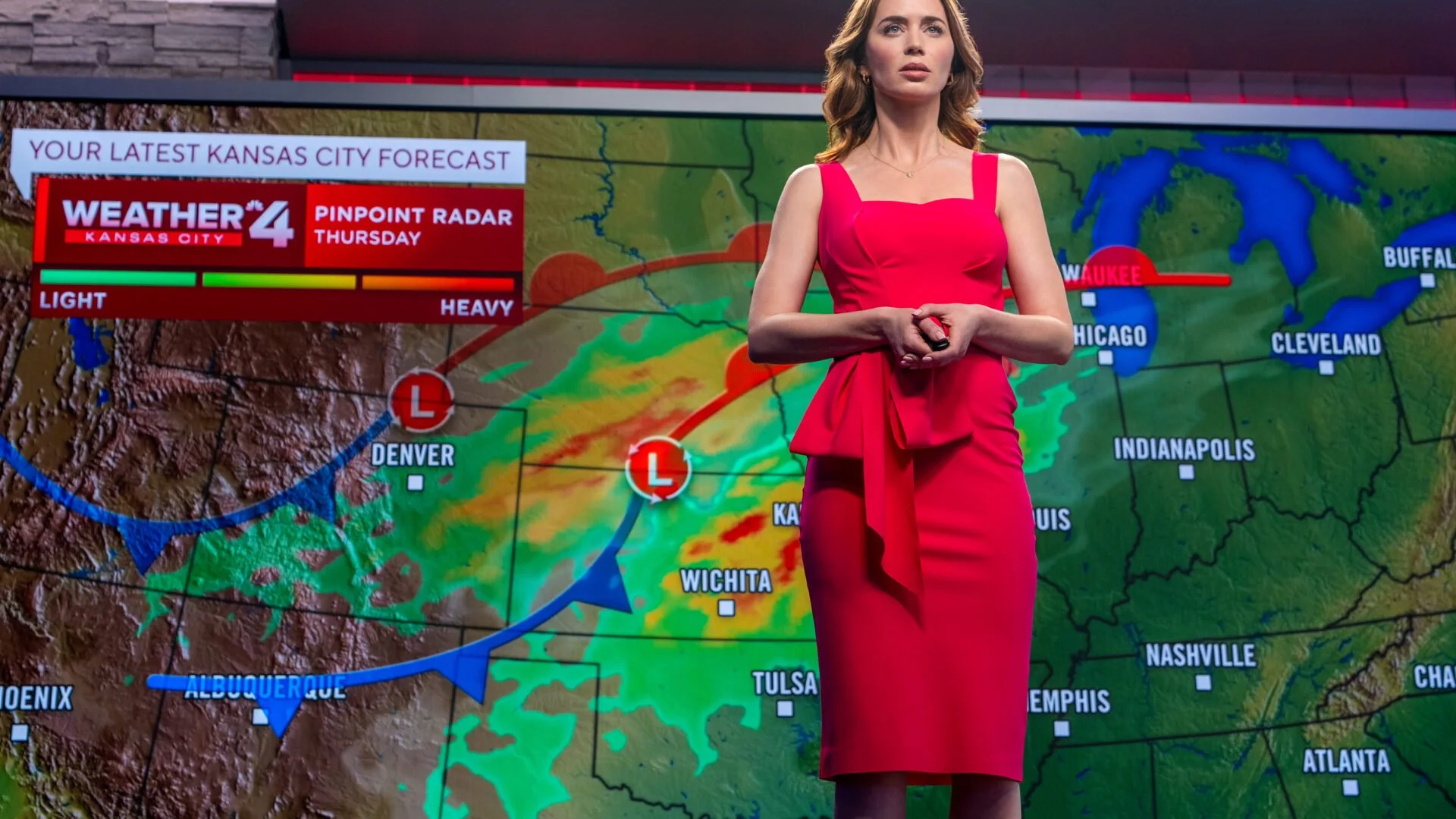
Emily Blunt in Disclosure Day
The film itself is basically an extended chase scene, and fortunately Spielberg’s direction of kinetic, spatially aware action remains second to none in a cinematic universe stuffed with muddy, congested CGI battles and too-close jittery hand-to-hand combat. A car chase that involves making a brief pitstop inside of a farmhouse is a highlight, followed closely by a vehicular set piece set adjacent to a moving train. In fact, every one of the best sequences in this movie involves some kind of motor vehicle. These scenes are brisk, powerful, and exercise a brevity that keeps them from overstaying their welcome and becoming wearying. It has become a meme at this point, but Spielberg’s talent for blocking scenes to pack the frame with as many interesting and informative visuals as possible remains unmatched.
If the movie had modulated these moments of kinetic action with more interesting, engaging moments of character work, we might have been looking at a visceral new classic. Given that the central objective of the heroes of the movie boils down to “telling people the truth,” one might expect that the film would concern itself mostly with the question of what the truth might do to us as a species. And yes, now and then the movie does stop to have a character speak out loud that question, but the answer is never considered or argued, only given. Everyone in the film has already made up their mind, and the only character who evinces even the smallest amount of ambivalence about the outcome that full disclosure will have has her concerns settled in a single phone call. Spielberg and screenwriter David Koepp seem to have no interest in the thorny, existentially fraught debate inherent in this premise, preferring instead to leapfrog over that conversation in favor of getting to the aforementioned action, assuming the audience will be on board immediately.
This is a fundamental flaw in the very structure of the film’s plot. The movie begins with Kellner already in possession of the discs and Hugo already dead-set on releasing the truth to the world. At some point each of these men must have believed in the mission of WARDEX, or at least sympathized with it enough to take part without rocking the boat. Watching their change of heart and tracking their recruitment into this wider movement of truth-telling might have made for an interesting story about dogma and conversion. Or, if Spielberg wanted to maintain his in media res storytelling, he might have allowed Scanlon a few more scenes to express the basis for his desire to keep the truth hidden. Balance physical chase and evasion with verbal jousting and intellectual grappling. As it stands, we get one scene where Scanlon and Hugo sit down, during which Domingo gets to give a soft, ill-defined treatise on how empathy is an evolutionary advantage. Game, set, match, apparently.

While the religious implications of disclosure are not ignored, they are hardly afforded proper time or weight.
Fine. But this lack of engagement and presumption of agreement leaves the film feeling like the extended final act of a more interesting and thoughtful film that we will never see. Characters respond to valid, earnest concern with pastel-colored catch phrases. Without truly weighing the potential repercussions of what definitive proof of alien life—advanced alien life, at that—would do to society, what we have here is an above-average chase leading to a coordinated data dump. This could be an interesting kick-off for an examination of how mankind wrestles with such a revelation, but that is also not what Disclosure Day has in mind. So what we are moving toward is neither the culmination of a powerful dialogue and debate nor the genesis of a revolution.
So what is this, then? It feels as though Spielberg had ideas but no thoughts when it came to the idea of disclosure. He is enamored of the idea that revelations about alien life might lead to some consciousness-elevating introspection, that mankind as a whole might pause, wait with bated breath, and be open to something more. But what next? If I smack a stranger in the face he might look at me in shock, but that’s hardly as important as whatever he chooses to do next. Spielberg has ideas about what he hopes aliens might want, but his best-case-scenario feels pointedly murky and idealistic, lacking in moral complexity or even moral curiosity.
Readers might notice that this review didn’t use the term “science fiction” once. In fact, it’s a genre identifier that has been avoided at all costs. At various times, characters use a piece of alien technology that can do whatever they need it to and that either is limitlessly powerful or degrades physically like a car that falls apart instead of running out of gas. This is a fantasy film cloaked in the trappings of science fiction feigning interest in existential questions about the nature of our actual universe. The aliens in this film could just as easily be wizards or fairies. As such, the plot and the ideas feel generic, shallow, and ephemeral.
Spielberg remains the world’s preeminent cinematic craftsman for set pieces and visual storytelling. And while his idealism and empathy are laudable, the story of Disclosure Day could have used a balancing energy to draw out and sharpen the thought-provoking conversations that Spielberg and Koepp preferred to keep undisclosed.