‘The Odyssey’ Wrestles With Giants Both Moral and Mortal
Christopher Nolan wants to know what we did that broke the world; and whether or not it can be fixed.
What other possible conclusion could be drawn from his work? Oppenheimer watched a man with limitless imagination and curiosity unleash a power with the potential to end all human life and then try to talk the genie back into the bottle. Tenet—which I am pleased to see is gaining more of a following with each passing year—wonders if at some point the future might attack the past as a means of trying to head off our destructive and damaging decisions. Interstellar, his so-far undefeated magnum opus, observes the kind of human sacrifice and institutional lies that might be required to move our species beyond our doomed planet. Even Memento revisits a negative genesis while trying to answer the questions of what kind of self-imposed amnesia might be required to overcome it.
All of these themes and more find a home, ironically, in Nolan’s latest film, The Odyssey, based on the 3,000-year-old epic by Homer. The story follows Odysseus (Matt Damon), the king of Ithaca, who follows Agamemnon (Benny Safdie) to war in Troy, leaving his wife, Penelope (Anne Hathaway) and son, Telemachus (Tom Holland), to guard his throne for nearly 20 years. Only ten of those years were spent at war; the rest were spent on an ill-fated attempt to return home, through rough seas and over treacherous terrain and against a mounting, unspoken ambivalence.
It should come as no surprise at this point that Nolan would be drawn to such a story. Arguably all of his films involve heroes who long to both expunge their failures and return home after achieving atonement. Will Dormer in Insomnia worries that his lie will undo a lifetime of work as a detective. Bruce Wayne battles costumed villains in order to save the city he left to decay in his own depression while longing to return to a civilian life with his childhood love. Cobb in Inception seeks legal exculpation for the death of his wife so he can finally return to the children he can only see in his dreams. The story of a hero fighting against the wrath of actual gods to find a way to his family and his throne must have sung to him like the sirens of antiquity.
Luckily for Nolan, his technical acumen and his skill at weaving narrative timelines for maximum emotional impact keeps his film from crashing into the metaphorical rocks. His love of analogue, practical effects works to great effect in selling the kind of strength and will and scale that might get lost either in a CGI soup. One of the most striking scenes in The Dark Knight Rises was a street brawl between cops and occupying anarchists, two blocks flooded with bodies in full conflict. The Odyssey bests that scene for scale of bodies and mayhem, showing the sack of Troy in a way that drives home the bloody, brutal reality of war.
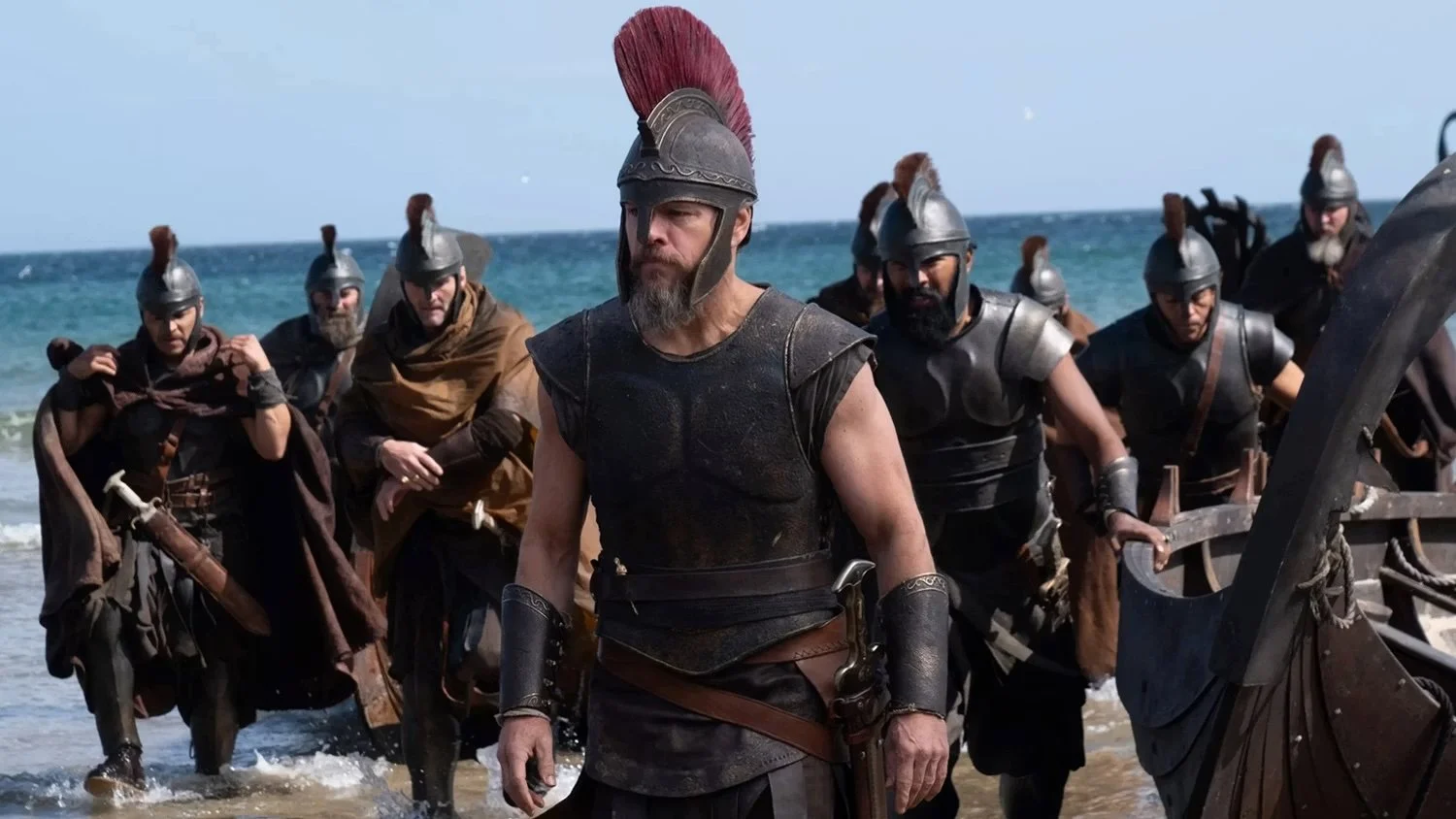
Let’s take a moment to linger on that word, ‘reality.’ Without wading into the discourse too deeply, a lot of digital ink has been spilled reckoning with certain decisions in this film’s production. Nolan, who composited no characters in Oppenheimer and who was taken to task for Dunkirk being too homogenous, is a savvy enough filmmaker to know when strict historical accuracy either benefits or hinders a story. I think that the attempted controversy over The Odyssey mistakes this story for a historical text, a tact that could have been taken by a director and writer with a very different objective in mind. (Robert Eggers springs to mind, though his work has a much different focus than Nolan’s.)
Nolan instead pushes toward the mythic, choosing elements to serve larger poetic and aesthetic concerns rather than being lashed to historical accuracy. The Greeks may not have worn broom-brush helmets or sailed these particular ships, but that’s fine. Aside from one casting choice that is legitimately distracting, all of his chosen digressions from reality serve the grander point of his story.
And this is his story. Nolan, like all storytellers who choose to adapt another work, saw reflections of his worldview as well as places where he could make alterations to better serve his point. Robin Hood, to take a more modern example, regularly bounds between being an anti-authoritarian rogue stealing from an over-taxing government (highly libertarian) and a rakish thief who steals only from the rich to give to the poor (pointedly left-wing). Man creates stories as a framework for their thoughts and ideas, and it is to our credit as a species that we can see so much within them even across ages.
This does require us to ask the question, though; what is Nolan’s story? His Odysseus, handily and ruggedly brought to life by Damon, is not a mythic hero of the kind one might expect. Rather than reveling in his power and his victory, he struggles with the reality of his choices. The Trojan Horse, a trick of his own invention, becomes his atomic bomb. It is a deception of monstrous scale, a violation of the unbreakable law of Zeus that demands hospitality, and a stepping stone to mass slaughter. The reality of his choice and what it wrought and his inability at first to reckon with his actions leads to his dithering on the way home, a choice that an audience will either find engrossingly cerebral or unnecessary modern.
This is where the classic idiom of ‘your mileage may vary’ comes in to play. One of the most interesting aspects of old stories like The Iliad or The Tain is the confidence of its heroes. Cú Chulainn in The Tain seeks glory, declares himself the best, and proves it constantly. His utter lack of humility is alienating but compelling and completely understandable. To see Nolan’s take on Odysseus immediately shift to guilt and ambivalence is jarring, feeling more modern than the source text might lead us to believe by at least 1,000 years. Rather than a Greek hero punished for his hubris and brought low by the gods, Nolan’s Odyssey seems to draw from a much different and older story, that of the Garden of Eden. The Trojan Horse becomes a symbolic apple, a means to destroy a safe haven from within, granting knowledge of good and evil.
Seeing this Judeo-Christian lens applied to The Odyssey as a story is strange but edifying. Nolan has been struggling with original sins for his whole career, from the personal (Inception) to the universal (Oppenheimer), the artistic (The Prestige) to the scientific (Tenet), and now he has finally wrestled with the spiritual and moral. Oppenheimer gave us a tool to wipe out the world, but Nolan’s Odysseus gave us the will to break the moral bonds of kindness and honesty given to us by God(s).
The knowledge of this evil choice and its impact on the world is what drives him to delay his homeward trip, and that guilty, selfish choice is what dooms him and his crew. From the Cyclops lair, a strange and uneasily sedate and hopeless interlude, to the impotent battle against the Laestrygonians, the perils that befall the crew are viscerally and horrifically observed. Even though it takes place at the midpoint of their trials, the horrors reach their visceral apotheosis when the crew visits Circe (Samantha Morton). In a movie that sees Nolan perfecting his craft in scene after scene, it is the episode in Circe’s cabin that finds him doing something wholly, repulsively new.
The first two-quarters of the movie wrestle with these story beats in retrospect. Telemachus goes on a journey to find news of his father and is told stories of his departure and the sack of Troy. An aged Odysseus struggles against the induced amnesia of the lotus flowers fed to him by Calypso to remember his choices, to locate the reason he feels so lost and drive to return to the sea. These narrative choices make sense, but much like our hero the audience can feel slightly waylaid in these moments. One can only watch boorish suitors like Antonius (Robert Pattinson, suitably weaselly) rowdily attempt to goad Penelope into marriage for so long before they begin to chafe. Luckily, our protagonists agree. Hathaway growls and rages against the cruelty of her fate while Holland attempts to force his own maturation so he can finally do something to change his and his mother’s circumstances. At the instant the endgame is set and storytelling give way to present tense action, my audience and I burst into righteous applause.
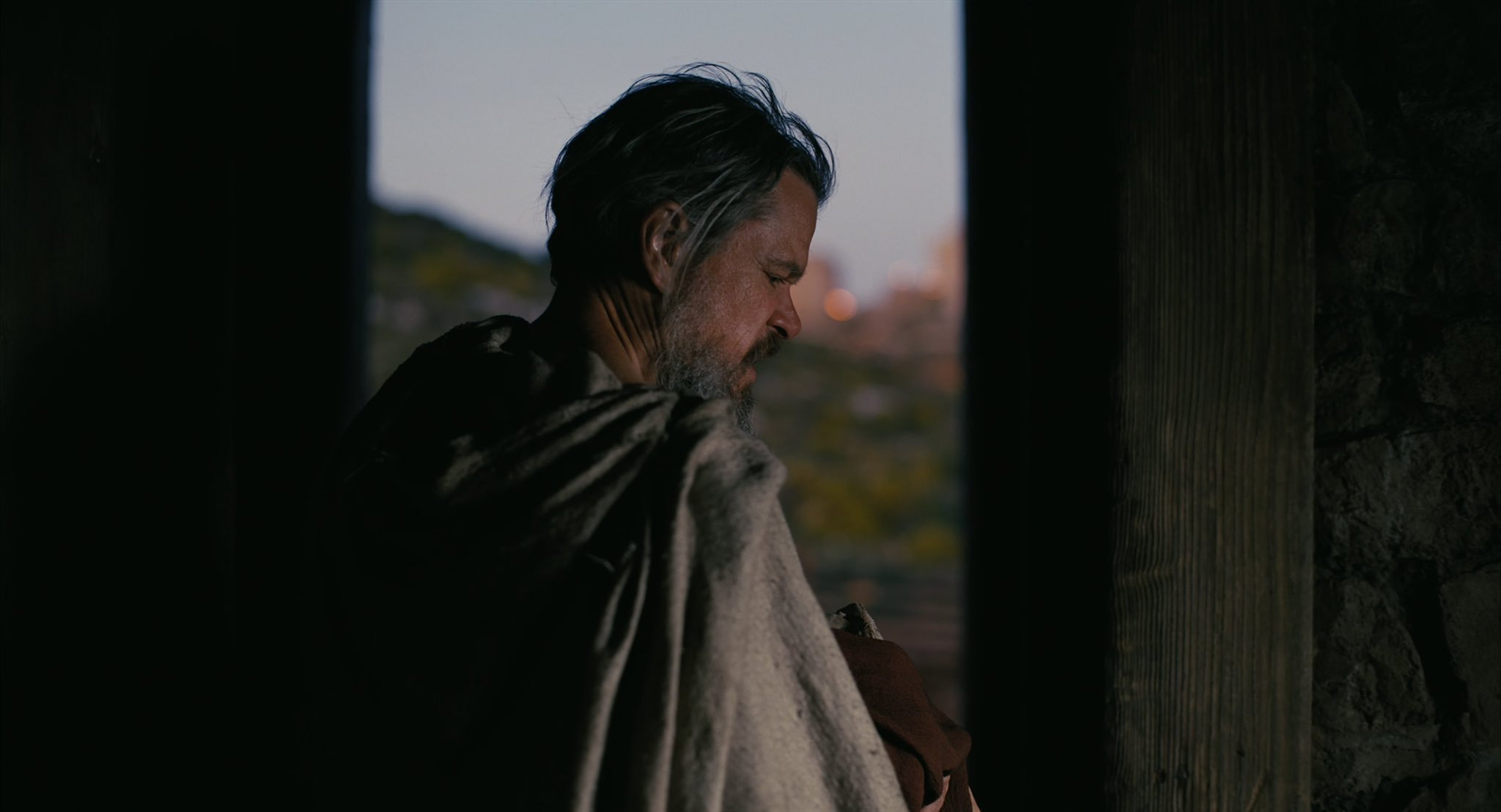
It may take another viewing (or two) to determine how well-regulate this narrative journey is. How tight was Nolan’s architecture, the balance between being adrift and being propelled? Did he become too enamored of his picaresque digressions, convinced of their muscular power to entertain based on set piece alone; or did he know how long he needed to spend at sea in order to effectively ramp up into the cathartic third act? Knowing him after two decades and a dozen films, I believe he has earned the benefit of the doubt—that subsequent viewings will show the clockwork precision of his pacing.
And if future viewings reveal that, like his hero, Nolan allowed himself to become distracted on the way home, it is still true that the experience of watching The Odyssey was singular and impressive. Ludwig Göransson’s score drives the film like a southerly wind, and Hoyte van Hoytema’s images remained impressed upon my mind long after the glorious 70mm print has stopped spinning. Actors like John Leguizamo and Mia Goth sing with limited screen time while Damon and Hathaway and Holland make fresh and moving humans out of mythic figures.
Nolan has used Homer’s epic to wrestle together his narrative obsessions with original sin, the utility and burden of memory, and the cruelty of time, crafting a harrowing piece of cinematic magic that is crowd-pleasing and thought-provoking in equal measure. In its abstraction of history and its use of a more modern moral lens, it plays like an old beloved song performed by an artist who holds it dear but is unafraid to pour a bit of themselves into the intonation.